
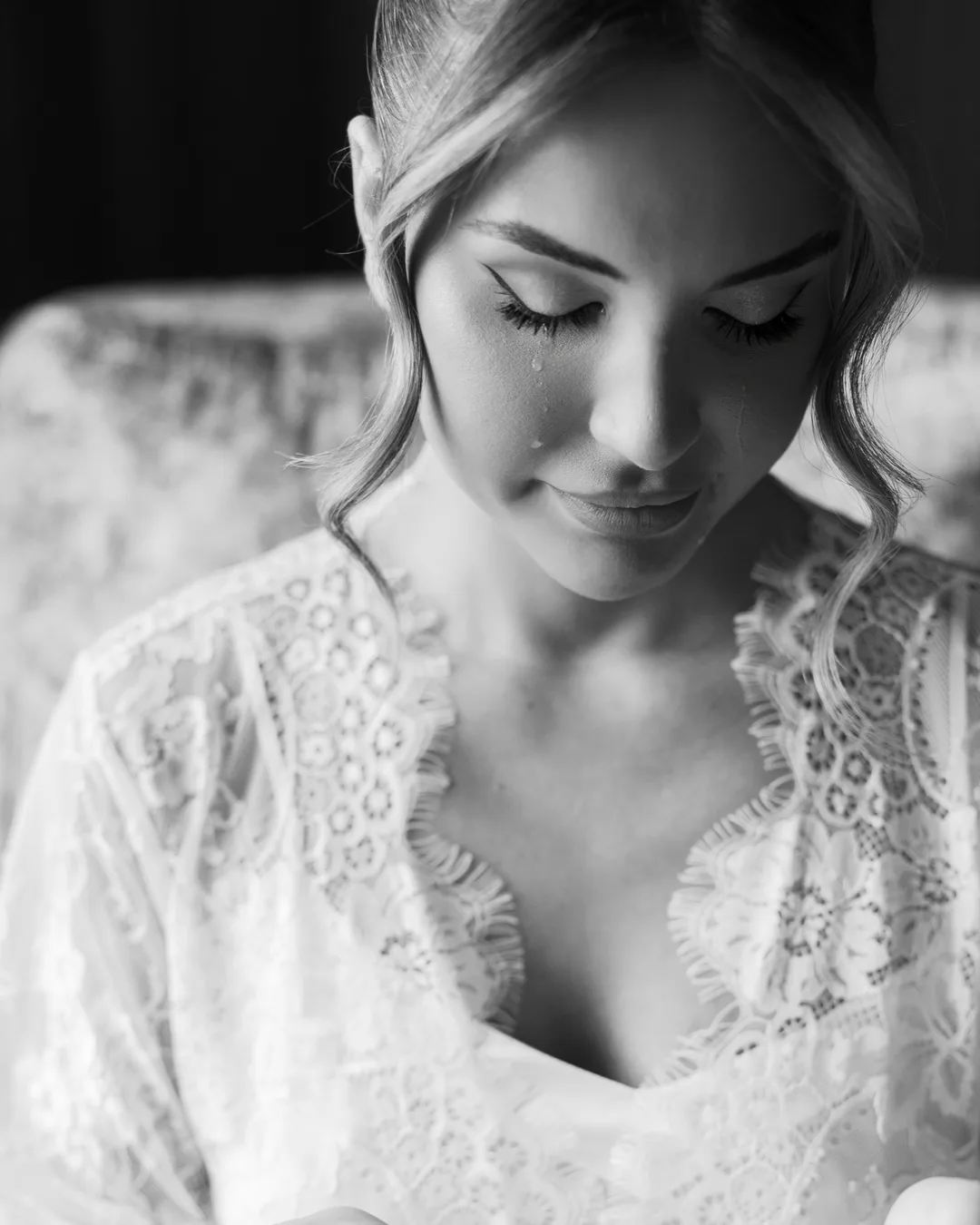
The photograph that explains my work best
My work starts long before the brush. And sooner or later, she is going to cry. Every bridal makeup in Porto I do is built for that moment.
The image at the top of this page is a bride reading the groom's letter on the morning of the wedding. She is crying. Look at what did not happen.
The mascara did not run. The eyeliner did not smudge. The foundation did not split where the tear passed. What you see on the skin is the tear, not the damage a tear usually leaves behind.
That photograph was not luck. It is the result of decisions made weeks earlier, at the trial, and of a way of working I have been refining ever since I started. It is the part of my job I am proudest of, and it is also the reason a lot of brides come to me.
Hollywood now prefers makeup that looks like it is not there
For years, bridal makeup meant more or less the same thing almost everywhere: heavy foundation, hard contour, dark smoky eye, nude lip. A kind of uniform. It looked good in a studio photograph and strange in person.
That changed, and it changed in Hollywood first.
Anyone who follows red carpets can see it. Skin stopped being a uniform surface and got its texture back. You see freckles. You see pores. You see the natural shine high on the cheek, the kind that shows up when skin is properly hydrated rather than when we throw powder over it. The work is there, and it is far more work than before, but you do not see it.
There is a technical reason for the shift, and it is not aesthetic. It is the camera.
The machines changed. A phone today captures detail at a level that ten years ago needed professional equipment. At weddings, nearly every guest is filming in high resolution, often in slow motion and a few centimetres from the face. What distance used to hide now shows up: the line where foundation ends, powder collecting in expression lines, the contour that looked soft in person and reads as a shadow on video.
So the technique had to reinvent itself. I work in thin layers now, building coverage only where it is needed and letting everything else breathe. I use less product than I used to and I take longer. I prepare the skin with the same care that used to be reserved for the eye, because the skin is what does or does not survive fourteen hours of a wedding.
The trend has a name abroad, skin first, but the name matters little. What matters is the result: the bride looks in the mirror and recognises herself. And her mother, who watched her grow up, does not say "you look so different". She says "you look beautiful".
Surviving tears is a technical decision, not a lucky break
Here is the problem almost nobody explains to brides: water resistance and longevity are two different things, and a product can have one without the other.
A foundation can last fourteen hours and fall apart at the first contact with moisture. A mascara can be waterproof and still develop that grey halo under the eye after six hours, not because of tears but because of the natural oil of the eyelid. Those are failures with different causes and they get solved in different ways.
Around the eyes, which is where everything is decided, I work with water-resistant formulas and set in layers, letting each one settle before the next. It sounds like a detail. It is the difference between a tear that runs over the makeup and a tear that takes the makeup with it.
On the skin the logic is different. Longevity does not come from the amount of product, it comes from the preparation. Skin that is properly hydrated and balanced grips the foundation and holds it in place. Skin that is too dry or too oily pushes it off, and no setting spray in the world fixes that afterwards.
There is one more detail that only years of weddings teach you: the difference between crying at the ceremony and crying at the reception. At the ceremony the bride is fresh, the makeup is two hours old and it survives almost anything. At eleven at night, after the heat, the hugs and the dance floor, the same tear meets tired makeup. It is the second situation you work for, not the first.
Products do not do the work, but they decide whether it lasts
There is a romantic idea that technique is everything and the materials are a detail. It is not true, and anyone whose skin has melted by five in the afternoon knows it.
My criteria for choosing a product are simple and have nothing to do with marketing. I test on myself first, then at trials, and I ask three questions. How does it behave at eight hours, not at two. How does it react to heat and humidity, which at a summer wedding in the Douro is not a minor point. And how does it show up on video with flash, which is where most products fail.
I replace parts of my kit several times a year and I keep training, in Portugal and outside it. I do it because what was the best product three years ago has been overtaken, and because a bride does not get a second chance to get married in good makeup.
I bring the Brazilian school with me, the one known for skin that survives a whole party. I apply it with the lightness that current photography demands.
The most important part is understanding exactly what the bride wants
I am going to say something that may sound odd coming from a makeup artist.
The hardest part of my job is not technical. It is listening.
A bride arrives at the trial with a phone full of saved photographs. But photographs rarely say what she actually wants. They say what she found beautiful on someone else, with another face, another skin, another light and, often, a filter. If I copy that, I do technically correct work and hand over a bride who does not recognise herself.
So I ask questions before I open the kit. How do you usually do your own makeup. What have you never liked seeing on your face. Whether you have ever felt masked. What the dress will be, the hair, the light at the ceremony, the hour of the reception. Who the groom is and what he is expecting to see when you walk in.
Often the answer that matters shows up halfway through the conversation, almost by accident. One bride told me she only wanted to "not look like me at a carnival party". Another admitted, a little embarrassed, that she was afraid her father would not recognise her. Neither of them had shown me that in a photograph.
After that I do the visagism analysis. I study the proportions of the face, the angles, the direction of the gaze, the tone and undertone of the skin. I design the makeup from the structure that is already there, not from a reference. That is why I always insist on the trial, weeks ahead. It is not to test colours. It is so that we both arrive at the wedding day knowing exactly what is going to happen.
On the day, I want the bride not to think about her makeup once. Not to touch it up, not to worry about it. If she forgot she was wearing makeup, I did my job.
Brides coming from abroad
The studio is in Greater Porto, in Vila Nova de Gaia, but a good part of my work happens elsewhere.
I get enquiries from brides in other districts who arrange the trial around a trip to Porto and then ask me to be with them on the day, wherever the wedding is. Douro, Braga, Guimarães, Viana do Castelo. And I get couples who choose Portugal to get married in and organise everything at a distance, in English, until they land a few days before.
When a bride from another city travels just to do a trial, that tells me more than any number.
What they say afterwards
I should not be the one writing this part, so I will leave their words. They are public, with names, on Google.
I had my wedding makeup done by Lari and I could not have made a better choice. She is incredible, the makeup was perfect, she is a sweetheart and super professional.
Larissa is incredible. She did my wedding makeup and it turned out perfect. She is very attentive and a great professional. The makeup stayed intact all night. Thank you for being part of one of the most important days of my life.
Notice what they single out. It is not the technique. It is the attention and the calm. That does not surprise me. Technique is the baseline, the minimum you ask of a professional. What stays in a bride's memory is the whole morning.
The rating currently sits at 5.0 from 58 Google reviews. I do not write that out of vanity. I write it because the brides built it, one at a time.
One last thing
If you are planning your wedding and still saving inspiration photographs, keep saving them. Bring all of them. But come with your doubts too, and with the thing you do not like about your own face, which tends to be the most useful information a bride can give me.
And do not worry about the crying. That part is mine.
Larissa Wendler, bridal makeup artist in Porto