
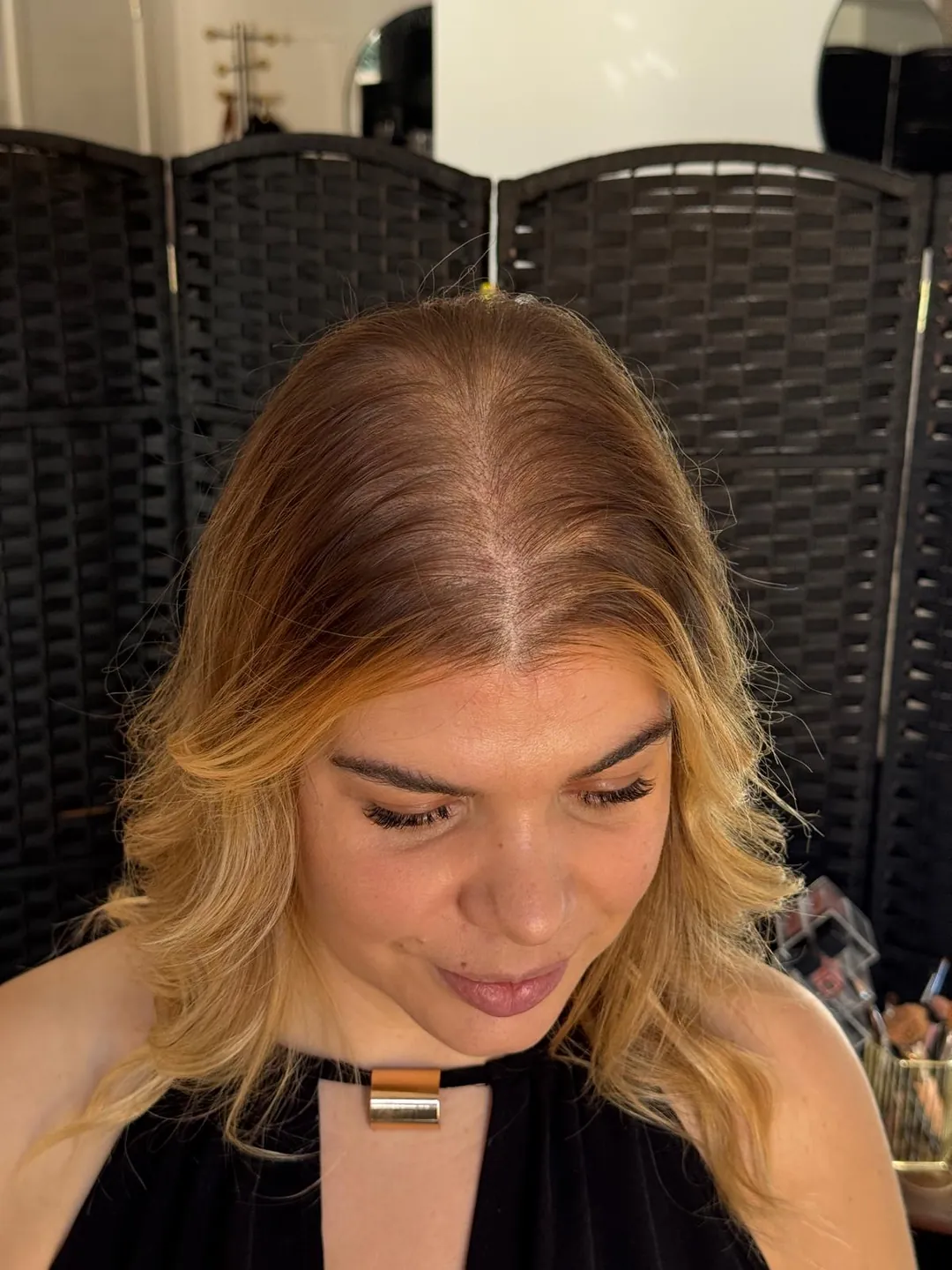
What scalp micropigmentation is
A non-surgical cosmetic procedure. Specific pigments go into the scalp to imitate the look of hair follicles, to disguise pattern baldness, thinning patches or scars. It belongs to the same family of techniques as the microblading in Porto I do on brows, and much of the aftercare is shared.
How the technique works
A digital device holds a fine needle grouping that places pigment in the upper layers of the scalp. Each pass leaves a dot. Thousands of those, at the right spacing and depth, read as short hair from conversational distance.
The work is slow because the density has to look irregular. A grid of evenly spaced dots gives away a bad job, and no colour correction fixes it.
How it differs from a conventional tattoo
The process looks similar and the two are not the same thing. Micropigmentation uses pigments made for this purpose, which fade rather than shifting into blue or green the way tattoo inks can, and it goes into a shallower layer of skin. That is why it reads as a follicle, not as a line of ink. At the studio in Porto the same technique is used on brows, with microblading and micropigmentation.
In the EU both tattoo and permanent makeup pigments fall under the REACH restriction in force since 4 January 2022. Ask whoever works on you which pigments they use.
What it is good for
What it can do
- Thinning areas on the scalp stop showing through
- The hair reads as denser than it is
- The look of a closely shaved head on a scalp that will not produce one
- Scars from surgery or a hair transplant blend in
People stop checking shop windows for how the light falls on their head. That is usually the part they mention afterwards.
Who it suits
- Androgenetic alopecia, male or female pattern
- People who have had a hair transplant and want more visual volume between grafts
- Anyone wanting to cover scars or patches on the scalp
The procedure, step by step
1. Assessment. Your skin type, how far the hair loss has gone, what you expect to see. Also where I say no if the answer should be no.
2. Design and colour. Pigments matched to your natural hair tone, and a decision about where the hairline sits. A hairline placed too low ages badly: the face changes and the line does not.
3. Application. Across sessions, usually two to four. The first builds a base deliberately lighter than the target; each one after it adds density.
4. Final review. Adjustments to even out the result once it has healed.
Care before and after
Before
Avoid heavy sun on the scalp, and skip oily products on the day of the session.
After
Keep it dry for three to five days. No sun, no pool, no sauna in the first week. Then hydrate with what I recommend: a dry scalp holds pigment worse.
What it costs and what that depends on
I do not quote a figure over the phone without seeing the head. It comes down to three things: the area to be treated, how many sessions that area needs, and the contrast between hair colour and scalp colour. A receding hairline takes less time than a full scalp, and the quote follows that.
| Type of treatment | What it involves |
|---|---|
| Localised area, up to 10 cm | One small, defined zone. Usually the shortest treatment. |
| Partial (hairline and temples) | Drawing the front line and filling the temples, charged per session. |
| Full scalp | Three to four spaced sessions, so density builds in layers. |
To find out what it would be in your case, message me on WhatsApp. Tell me the area you want treated and, if you can, send a photograph in natural light. I reply with a written quote, with no obligation.
How long it lasts
On average the result holds between two and five years. Skin type, aftercare and sun decide where in that range you land, and sun is the one you control. Top-up sessions extend it.
It fades gradually, with no point where it drops off. People tend to book a refresh before anyone else notices.
Risks and contraindications
- Not suitable where there is active skin disease on the area
- A known pigment allergy needs a patch test first
- It needs someone who has worked on scalps: the depth that suits an eyebrow leaves a blur here
Frequently asked questions
Does scalp micropigmentation hurt? Discomfort is low and managed with a topical anaesthetic. Most people find the sound worse than the sensation.
Can I wash my hair normally afterwards? Yes, once the initial healing is over. Leave the first three days alone.
Is it reversible? The pigments lighten naturally over time, and laser removal exists. Not a decision for a Friday afternoon, and not permanent either.
A hairline drawn where the client wants it today is the one she will resent in ten years. That argument is part of the job.
Larissa Wendler, makeup artist and visagist in Porto
References
- ECHA: Tattoo inks and permanent make-up: since 4 January 2022, entry 75 of Annex XVII to REACH restricts over 4000 substances in tattoo and permanent makeup pigments.
- Regulation (EU) 2020/2081: full text of the restriction, with the derogation for Pigment Blue 15:3 and Green 7 applicable since 4 January 2023.