
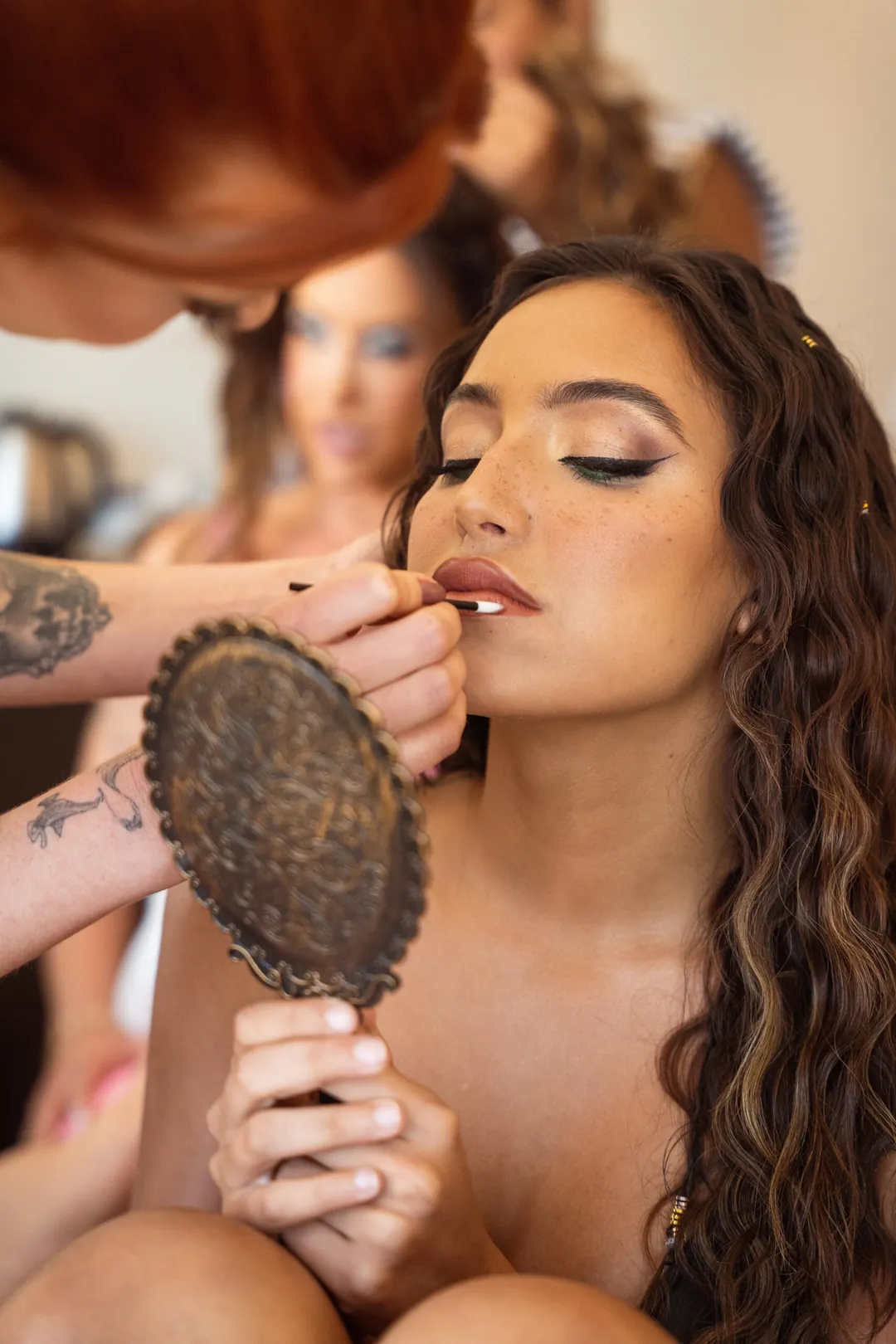
What the course actually is
Progressive modules, where each lesson assumes the one before it. The focus is facial structure, colour balance and the techniques that make makeup last past the second hour, rather than just putting product on a face. The programme covers skin preparation, correction and neutralisation, building a smoky eye, contour and highlight, and harmonising tones and finishes. For anyone who prefers to learn in person, there is also the makeup course in Porto, in individual lessons.
The difference between this and a folder of saved tutorials is the sequence. Tutorials show you a result. A student who understands why a technique works can adapt it. One who only copies the how is stuck the moment the face in front of her is not the face in the video.
Who it is for
It suits you if you want to learn makeup from zero, if you want to do your own makeup with confidence, if you are already working and want your technique rebuilt properly, if you are planning to start out as a makeup artist, or if you create beauty content and are tired of guessing.
No previous experience is required. What decides how far you get is consistent practice, not talent.
What you will be able to do
A course that stops at theory is worth very little. By the end you should be able to prepare skin so the makeup lasts, correct dark circles and pigmentation, adapt a smoky eye to different eye shapes, apply liner in proportion to the eye rather than by copying a shape, balance contour and highlight, and finish soft or dressed up depending on what the day asks for. On different face shapes, including your own.
With a structured method, the change is visible in a few weeks of practice. Not in a weekend.
Online or in person
Both formats teach. They ask different things of you.
| Online course | In-person course | |
|---|---|---|
| Flexibility | 24h access, no fixed hours | Set timetable |
| Pace | Yours | Set by the group |
| Review | Unlimited | Only in the moment of the class |
| Location | Anywhere | You have to travel |
| Structure | Recorded, structured modules | Live learning |
If your week is already full, the online format bends around it. If you learn best with someone correcting your hand in real time, tell me and we talk about the studio instead.
Why the online format works
You can pause a lesson at the point where your hand stops obeying you, rewind it, and try again with the brush in your hand rather than in your memory. That is the part students mention most, along with practising while the lesson plays.
Structured digital teaching holds up against in-person teaching. Unstructured video does not.
How to judge any online makeup course
Not every course has technical depth. Before you enrol anywhere, mine included, look at the trainer's professional experience, whether the modules have a clear structure, whether the content is demonstrated rather than narrated, and whether questions get answered.
Professional makeup asks for technique, precision and an eye for proportion. Visual inspiration on its own does not get you there.
Frequently asked questions
Do I need a lot of products to start?
No. A basic kit is enough to begin. As you progress you can invest gradually in specific products, and I would rather you bought four things you use than twenty you do not.
Is an online course enough to work professionally?
With dedication and steady practice, a structured course gives you a solid technical base. Practical experience on real faces is the part that completes it, and nothing replaces it.
Do I get a certificate?
Yes, a digital certificate of completion. Ask me about it before you enrol if it matters for where you plan to work.
Can I watch on my phone?
Yes. Phone, tablet or computer, and you can pick up where you stopped.
Start building your technique
Write to me and tell me your level and what you want out of it. I will tell you honestly whether the course fits or whether you need something else.
Makeup is technique and proportion before it is aesthetics. Learn at your own pace, with guided practice.
A serious online course is not measured by the number of lessons. It is measured by what the student can do on her own at the end.
Larissa Wendler, makeup trainer in Porto
References
- Regulation (EC) No 1223/2009: the European framework for cosmetic products, covering composition, labelling and safety assessment of everything applied to the skin.
- INFARMED: the national competent authority for cosmetic products in Portugal.