
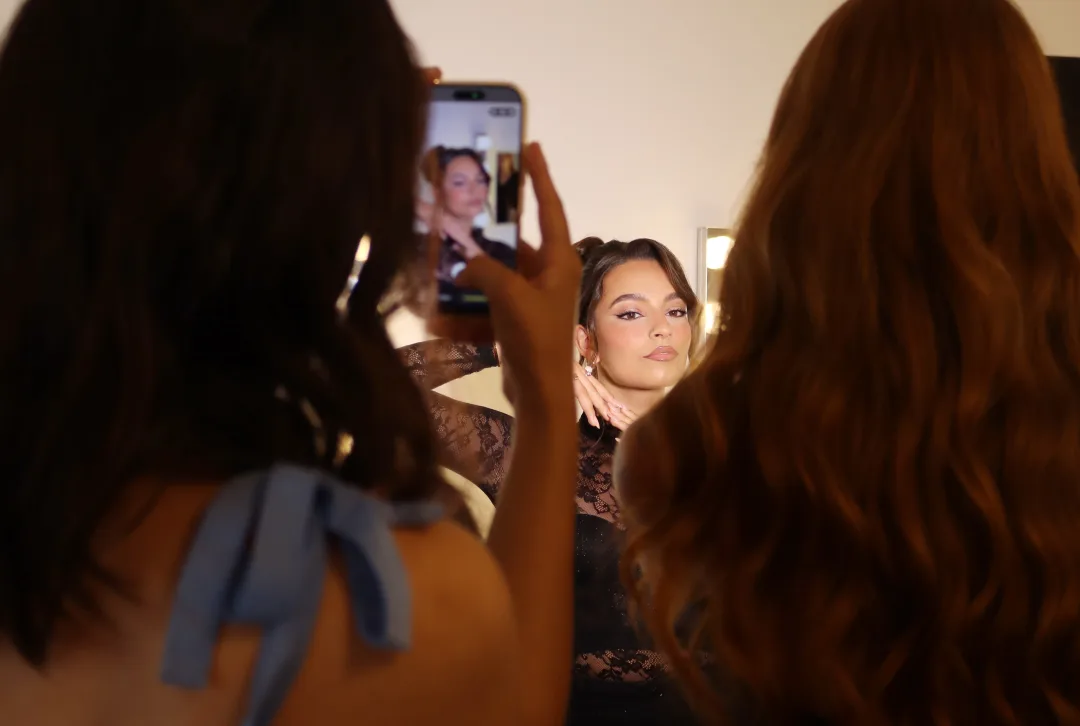
I get this question from two kinds of people. One wants to get better at doing her own makeup. The other wants to work in makeup. The right answer is not the same for both. I teach both formats, online and in person, in my makeup course in Porto, so here is what each one gives you.
Because I teach both, I will not tell you one is better. I will tell you what each one gives and what neither of them gives.
The short answer
If you want to learn for yourself, at your own pace, and already have some practice: online will do.
If you want to do makeup on other people, charge for it, or are starting from zero: you need in person, with or without online alongside.
There is one reason, and it outweighs the rest: doing your own makeup and doing someone else's are two different skills. On your own face you work in a mirror, with the image reversed, and you know every millimetre. On a face that is not yours, you work head-on, with your hand at the wrong angle, and you have no idea how that skin behaves.
What each format gives you
| Feature | Online | In person |
|---|---|---|
| Pace | Yours: pause and repeat | Real time, at the lesson |
| Review | Unlimited | Limited to the lesson itself |
| Hand correction | None | Immediate, as it happens |
| Practice face | Your own | Other people's, with different skin |
| Travel | None | To the studio in Greater Porto |
| Materials | What you already have | Included in every lesson |
The row that decides almost everything is the third. Learning a technique wrong and repeating it for months is harder to correct than learning it from scratch.
Where online is better
I am not describing online as a lesser format. There are things it wins at.
The theory stays available. The order of application, the difference between undertones, what each type of brush does. You can review it before every job; in a room you hear it once.
There is no timetable. Anyone working shifts or with small children knows what that is worth.
You can repeat without embarrassment. Watching the same movement twenty times is normal at home and impossible in a class.
Where in person cannot be replaced
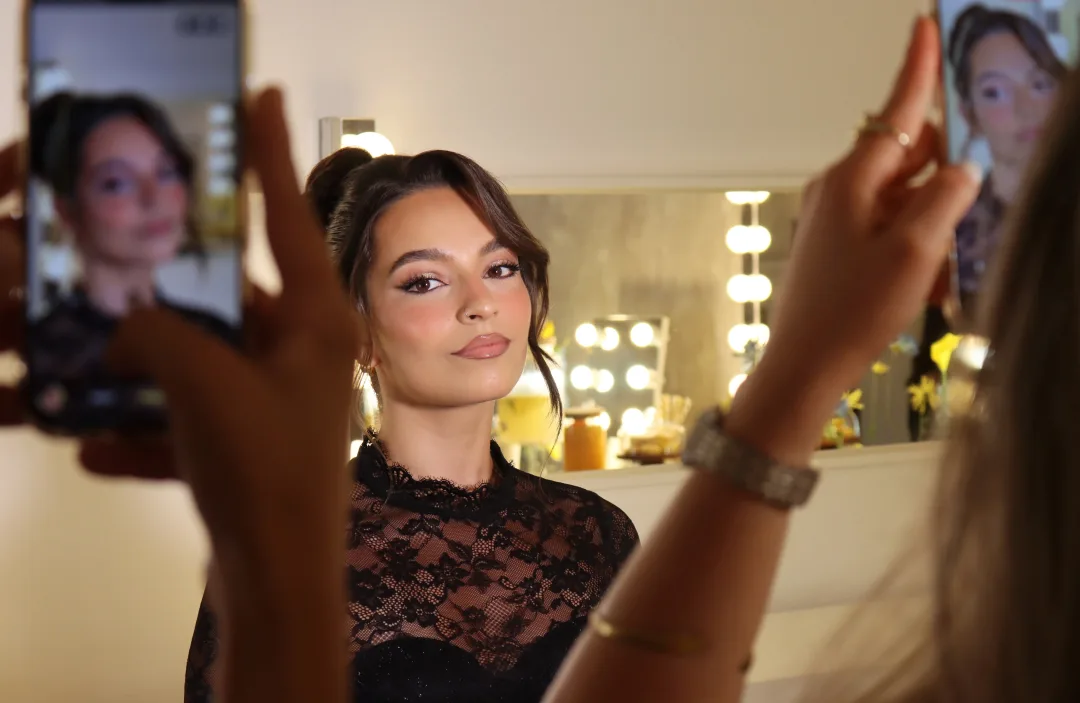
Three things happen in a room that a video cannot do.
Correction arrives at the right second. I see the brush at the wrong angle before the product sets, not after the work is done.
You work on skin you did not choose. Oily, dry, mature, textured. That is what you will meet when you start charging.
You learn to manage time. Doing beautiful makeup in three hours is not hard. Doing the same in fifty minutes, with the client watching the clock, is something else.
How to choose, in three questions
Will you do makeup on other people? If so, in person. There is no shortcut.
Do you already do makeup and want to improve one technique? An advanced in-person module gets you there faster than a full online course.
Do you want to learn for yourself, with no rush? Online is enough, and a self-makeup lesson afterwards closes whatever is still unclear.
How my lessons work
In-person lessons are usually private: one student and me, at the studio, on a date we agree together. All the materials are included, and you leave with a certificate and a booklet summarising the lesson.
For a self-makeup lesson, we also talk through products: what suits your skin, what is missing and what you may be using the wrong way.
I also run group masterclasses at the studio, with the dates announced on Instagram and TikTok.
The online makeup course is for theory and review. It works well before or after in-person training, and less well on its own for anyone who wants to turn professional.
Lessons are in Portuguese or English. It is worth saying which you prefer in your first message.
Frequently asked questions
Is an online makeup course worth it?
It is for theory and review: products, order of application, reading tones. What online does not give you is someone correcting your hand while it happens, and that is where most mistakes take root.
What is the difference between an online and an in-person makeup course?
Online, you watch, pause and repeat whenever you like. In person, you work on a face that is not yours, with immediate correction and the pressure of real time. They are different skills and they complement each other.
Do I need experience for in-person training?
Not for beginner training, which starts from the beginning. For the advanced module you need to be doing makeup already, because the work is on specific techniques, not on the basics.
Do I need to bring materials?
No. In every lesson the materials are mine, and you do not need to bring or buy anything before coming.
Are the lessons in English?
Yes. I teach in Portuguese and in English. Tell me which you prefer when we first talk.
Do I get a certificate at the end?
Yes, with your name as you want it on the document. If the certificate matters for where you plan to work, ask me before you sign up so we can check it will serve.
One last thing
If you are undecided and the goal is to turn professional, start in person and use online afterwards to review. The other way round works badly: you arrive in the room with habits already formed, and undoing a habit takes more lesson time than learning from scratch. In-person lessons are at my studio in Greater Porto.